Splitting the Emissions Baby: Allocating GHG Reductions in the Electricity Sector Part II

In my last post, I discussed the dilemma of how to allocate the avoided greenhouse gas (GHG) emission between policies that policies to increase renewable electricity and reduce electricity consumption. Estimating the effects of increased renewable first will artificially increase the avoided emissions from that policy and decrease the emissions from efficiency. The opposite is also true. The post provided an illustrative example to demonstrate the challenge and to show that there is an overlapping amount of emissions that must be allocated – or split – between the two policies. It also shows the possible perverse outcomes if care is not taken with this issue. In this post, I will summarize our solution to this problem – our approach to “splitting the electric emissions baby.”

Splitting the Electric Emissions Baby

There is no standard protocol in the sequencing of calculation to prevent the allocation problem. Any assumption to put one measure before another is arbitrary. For example, California has a preferred order for serving incremental energy needs: efficiency first, then renewables, and then traditional sources. Using this order as a guide would overestimate the emissions from efficiency and underestimate the emissions from renewable energy. Our approach to overcome this problem is to allocate emissions between the quantity and rate policies based on the relative contribution to the combined reduction (rate plus quantity).
Continue reading →

Posted in Energy Efficiency, Greenhouse Gas, Renewable Energy | Tagged , , , , , , , , , | 2 Comments

INDCs and Why Cities are Important for Global Climate Action

As we approach UNFCCC’s 21st session of the Conference of Parties (COP 21) to take place November 30 – December 11 in Paris, expectations are high that more than 190 nations will be able to come to some kind of new binding agreement to reduce greenhouse gas emissions after 2020. In preparation for Paris, by decisions 1/CP.19 and 1/CP.20, it was agreed to invite all 195 members of the UNFCCC to submit their “pledges”, now known as Intended Nationally Determined Contributions (INDCs), by October 1, 2015. The INDCs can be considered Climate Action Plans (CAPs) on the grand, national level. As suggested by 1/CP.20 para. 15, INDCs may provide quantifiable information on a reference point such as a base year, scope and coverage, assumptions and methodological approaches, reductions, and show how the Party considers its INDC fair and ambitious towards achieving the objective of the Convention as set out in Article 2 of the UNFCCC. Article 2 states that “[t]he ultimate objective of this Convention… is to achieve…stabilization of greenhouse gas concentrations in the atmosphere at a level that would prevent dangerous anthropogenic interference with the climate system… within a time frame sufficient to allow ecosystems to adapt naturally to climate change, to ensure that food production is not threatened and to enable economic development to proceed in a sustainable manner.” Continue reading →

Posted in Greenhouse Gas, Legislation, Renewable Energy, Transportation | Tagged , | 2 Comments

Unpacking SB 350: CAISO Regional Expansion

The Governor signed SB 350 into law on October 7, 2015 (Chapter 547). SB 350, the Clean Energy and Pollution Reduction Act of 2015, makes changes to the state RPS, energy efficiency, and several other programs and statutes. This post will focus on the statutory changes that seek to expand the California Independent Systems Operator (CAISO) from the existing system to a regional independent transmission operator.

The CAISO is a nonprofit public benefits based corporation that provides open and non-discriminatory wholesale high voltage, long-distance transmission across approximately 80% of California and a small part of Nevada (Figure 1).   This makes the CAISO the largest wholesale transmission balancing authority in California with over 100 transmission owner and generator market participants. The CAISO system provides transparent information about the state of the wholesale grid (matching generation with load and maintaining electric frequency) and prices to participants.

Continue reading →

Posted in Energy, Legislation | Tagged , , , | 2 Comments

Splitting the Emissions Baby: Allocating GHG Reductions in the Electricity Sector Part I

One area of our work at EPIC is to provide technical support to cities, counties, and regional planning organizations in the climate planning process. This work includes estimating greenhouse gas emissions for inventories and the reductions expected from a variety of policies for climate action plans, typically in support of a climate action plan. Over the years our approach to this work has evolved to accommodate methodological challenges that arise, particularly those related to estimated the greenhouse gas reductions that may result from policy. This has gotten us thinking about the critical role methodology plays in the climate planning arena and how it may apply to estimating the future effects of Governor Brown’s climate policy targets and complying with federal policies like the U.S. EPA’s Clean Power Plan.

Continue reading →

Posted in Greenhouse Gas | Tagged , , , , , | 3 Comments

Addressing the Role of Electric Vehicles in Greenhouse Gas Reduction: California Public Utilities Commission

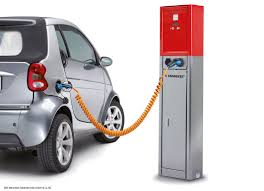
EV Charger

This is the second post in a series looking at legislative and regulatory action addressing Electric Vehicle (EV) greenhouse gas emission (GHGE) reductions. This post focuses on efforts by the California Public Utilities Commission (CPUC).

In 2013 Governor Brown, as the head of the executive, took the first step to electrifying California’s transportation market by issuing Executive Order B-16-2012, which set the long term goal of achieving 1.5 million Zero Emission Vehicles (ZEVs) on California Roadways by 2025 and a reduction of transportation-related GHGE by 80 percent below 1990 levels by 2050. The term “ZEV” refers to vehicles that emit zero tailpipe pollutants from the onboard source of power, which includes hydrogen fuel cell electric vehicles (FCEVs) and Plug-in Electric Vehicles (PEVs). The ZEV Action Plan provided the CPUC with deadlines, opportunities for collaboration with other California agencies, and specific tasks necessary to reach the Governor’s target, such as: developing electricity tariffs and pilot programs, reducing the costs of ZEVs by encouraging investor owned utilities (IOUs) to conduct consumer outreach concerning time-of-use (TOU) rates, and promoting consumer awareness by ensuring electric usage of PEVs is presented clearly on consumer’s utility bills and demonstrating savings compared to conventional gasoline and diesel fueling.

Continue reading →

Posted in Energy, Transportation | Tagged , , | 1 Comment

What is Business-As-Usual? Projecting Greenhouse Gas Emissions at the Regional Level

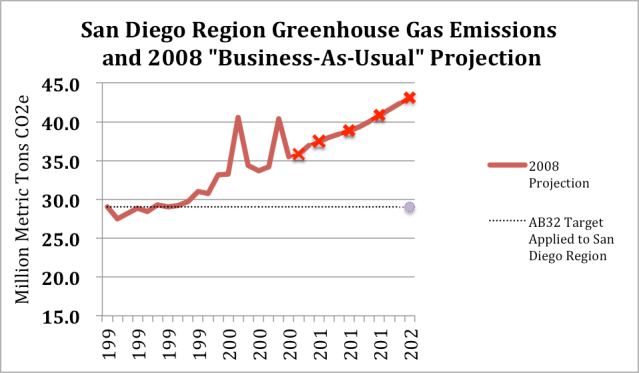
Projecting greenhouse gas (GHG) emissions is important because it helps us to assess how much the energy and GHG policies in place help to achieve targets set by law. For example, if we apply California’s AB32 target to the San Diego region, we would have to achieve the 1990 GHG emissions level (approximately 29 million metric tons CO2e) in 2020. To assess whether the policies we are enacting and implementing today can hope to achieve this target, we need a projection that tells us where we would be without these policies. Figure 1 shows the regional GHG emissions and a projection made in 2008 based on economic and demographic forecasts of the region (see San Diego County Greenhouse Gas Inventory September 2008 at http://www.sandiego.edu/law/centers/epic/reports-papers/reports.php). According to this projection, we would have needed to avoid about 14 million metric tons CO2e in 2020 to achieve the 1990 level.

Figure 1

Figure 1 San Diego region’s greenhouse gas emissions trends and 2008 BAU projection

Continue reading →

Posted in Energy, Energy Efficiency, Greenhouse Gas, Transportation | Tagged , , , , , , | 2 Comments

Half-Empty Planes: Utilization Rates for California’s Electric Grid Part II

transmissions lines

In Part I of this post, we discussed the concept of asset utilization — or load factor — and looked at recent trends for California’s investor-owned utilities (IOU). The trend over the past two decades for IOU load factors has been a decline from the 55%-60% range to the 50%-55% range. In Part II, we will explore the factors that affect load factor, whether there is an optimal load factor, and how California’s greenhouse gas policies may affect load factor.

Optimizing Load Factor

So, what is the optimal load factor for electric utilities in California? The short answer is that it depends. In a perfect world, we would design and operate our electric system to have a 100% load factor; that is, the average demand and peak demand are equal and we use all the capacity of the system all the time. Demand in this case would be flat – one level of demand every hour of every day of ever year. But, alas, we don’t live in that perfect world. Many factors contribute to load factor, including weather, customer type, and rate structures. As a result, there is no one-size-fits-all approach to determining the optimal load factor.  Continue reading →

Posted in Uncategorized | Tagged , , , , , , , , | 3 Comments

Half-Empty Planes: Utilization Rates for California’s Electric Grid Part I

airliner landing at dusk, panoramic frame

The electric grid is designed to handle the highest demand expected in a given period, commonly referred to as peak demand. Depending on many factors, the time needed for peak demand and period of high demand approaching peak can be a small percentage of the hours in a year. California utilities generally hit their peak level of demand in the summer, when temperatures are hot and air conditioners are running. But for most of the rest of the year, demand is relatively low. This means that there is capacity in the grid that is not used much of the time. To measure how much of this peak capacity is used on average we use asset utilization rates – or the more wonky term, load factor. This is not a new concept but one that rarely comes up in energy policy conversations.

We do hear about demand reduction, demand response, and load shifting. These important concepts are implemented through programs and tariffs offered by California utilities. They may also come up in relation to rate structures like time-of-use rates or the contribution of solar energy production or electric vehicles toward peak needs. These all are important topics in their own right but ultimately contribute to and affect overall grid asset utilization rates. 

Continue reading →

Posted in Energy, Greenhouse Gas | Tagged , , , , , , , | 3 Comments

June 2015 Legislative Update: Energy Procurement, Net Energy Metering, Electric Vehicle Chargers, and Green House Gas (GHG) regulation.

A. Direct Access (DA): SB 286

SB 286 would require a 2nd phase-in period to expand individual retail nonresidential end-use customers direct transactions over a period not to exceed 3 years, raising the allowable limit of kilowatthours that can be supplied by other providers in each electrical corporation’s distribution service territory by that electrical corporation’s share of an aggregate of 8,000 gigawatthours. The bill would require that all associated retail sales be procured from eligible renewable energy resources with enforcement under the California Renewables Portfolio Standard Program. Electrical corporation would continue to provide direct access customers with support functions through its own employees, subject to certain exceptions. Finally, the bill would prohibit an electric service provider from offering consolidated billing beginning January 1, 2016.

Continue reading →

Posted in Uncategorized | Leave a comment

June 2015 Legislative Update: CPUC, CEC, and Utility Reform

The following sections summarize proposed bills that have passed their house of origin with an emphasis on CPUC, CEC, and Utility reform measures.  Emphasis is given to proposed changes to Ex Parte rules.

A. California Public Utility Commission (CPUC) Reform: SB 48

Changes to CPUC President Authority: This bill would repeal the president of the Public Utilities Commission’s authority to direct the executive director, the attorney, and other commission staff and delete the authority of the president to direct or authorize the executive director and attorney to undertake certain actions, thereby requiring that they be directed or authorized to undertake those actions by the commission.

Continue reading →

Posted in Energy, Legislation | Tagged , , , | Leave a comment