Data centers are becoming an ever-increasing focus both because of their impacts to communities and ratepayers and because candidates are having to answer to voters on this issue with the midterm elections weeks away. This is the first in a series of blogs that will look at data centers in California, both existing and proposed, to discuss the current state of data centers and the future impacts of proposed data centers from a land use and energy perspective. This discussion will also speak to how the state prepares for load growth and whether this minimizes most risk from large load data centers. The series will also analyze recent legislation specific to data center construction where the state seeks to insulate non-data center ratepayers from the interconnection, electric supply, and transmission cost caused by new data centers. It will then analyze the current state of local government moratoriums (permanent and temporary) to provide information on and to what purpose these moratoriums serve. These blogs are intended to help set the stage for one of the main issues that will be front and center at our November 6, 2026, 18th Annual Lesley K. McAllister Symposium on Climate and Energy Law where the topic is Powering the Future: Navigating the Impact of AI Data Centers and Electrification. You can register to attend HERE.
I am not here to debate the merits of data centers. What I am trying to do is provide the context of how the state and utilities identify and plan for large load electric demand growth. According to the California Energy Commission (CEC), there are over 200 data centers in California that are estimated to operate at a capacity of approximately 1,000 megawatts (MWs) of electricity in 2026. Presently, this makes California the third highest in terms of the total number of data centers operating behind only Virginia and Texas but significantly smaller in terms of overall data center MW capacity. California will not maintain this status in the near to medium term as data centers are built out all over the United States. To put California in perspective, CleanView.co estimates neighboring Arizona data centers operate with ~3,649 MW capacity presently (planned 14,451 MWs) while Texas data centers operate at ~7,490 MW (planned 95,040 MWs) and Virginia data centers at 17,458 MWs (planned 39,927 MWs).
The CEC projects data center load to increase to 4,500 MW by 2040, but the number may be substantially higher and closer to 14,000 MWs if most current data center applications reach finalized agreements and projects become operational. The San Francisco Chronicle created a data center tracker out of CleanView.co data where you can get an idea of what exists and what is planned (including what has been canceled because of push back or moratoriums).
In this context, it is important to know how the state plans for large load data center growth. California forecasts demand biannually to determine how much supply should be built or contracted for to serve load that informs the Integrated Resource Planning ten-year supply procurement horizon. The following is taken from p. 51-52 & 56-57 of the 2025 Integrate Energy Report IERP (Adopted July 2026) that formed the demand forecast assumption based on submissions from seven utilities reporting on signed electric service agreement, application, and inquiry that shows PG&E as the primary territory that will serve growing data center load:
Table 7 Data Center Capacity Requests in MW by Utility and Status
| Status | Agreement | Application | Inquiry | Total |
| PG&E | 4,356 | 3,617 | 6,774 | 14,747 |
| SVP | 644 | 196 | 198 | 1,038 |
| Palo Alto | 14 | 0 | 55 | 69 |
| SCE | 72 | 3,174 | 1,378 | 4,623 |
| SDG&E | 0 | 0 | 100 | 100 |
| Burbank | 0 | 0 | 100 | 100 |
| VEA* | 0 | 2,600 | 0 | 2,600 |
| Total | 5,068 | 9,587 | 8,604 | 23,278 |
Source: CEC with data from utilities. *The CEA data center applications are for locations in Nevade but withing CAISO.
The CEC is currently in process to determine how to accurately forecast large load and what assumptions and milestones should be the basis for load modifications and load forecasting with much focus on data center loads. You can find the CEC’s record and notices in its Electricity and Demand Forecast Docket No. 26-IERP-03: specifically, TN# 272027 Presentation- Data Center Demand Forecast; TN#272043 Presentation- Load Energization Requests (Known Loads); and TN#272065 Presentation- PG&E Data Center Forecasting. This is an iterative, transparent, and constant undertaking that forms the central basis for what regulators and utilities expect to procure from a supply perspective. The CAISO also has a Large Load stakeholder process that began in February 2026 to address large load interconnection and related issues.
These processes have and will be able to account for new load requests should inquiries turn into signed agreements and operational data centers. For example, there will be new inquiries for new large load service with a recent local example being SDG&E and San Diego Community Power receiving an inquiry in November 2025 to power a 400 MW data center as part of the NAVWAR redevelopment (this potential project is something I will take a closer look at to discuss its implications in San Diego at a later date but generally Manchester Financial Group must build a new NAVWAR building for free and recoup these costs on the profits of other onsite development, such as a data center). This is the first and only large data center inquiry we know of in the most expensive utility service territory in the continental United States, SDG&E, where the largest existing data center is 11 MWs (this potential data center is now listed as “planned” on datacentermaps.com specific to San Diego suggesting the developer is looking for an off-taker of the compute). This is not the only city center being evaluated for redevelopment of land or repurposing buildings for data centers. The City of San Francisco received an inquiry in June 2026 as to what permits would be needed to repurpose the former site of Bloomingdales 350,000 sq ft store in the now shuttered San Francisco Centre mall into an AI data center. It remains unclear if either of these projects will come to fruition but if they do, the application for power will become part of planning at the state and utility level. Supply will be procured and distribution and/or transmission upgrades will be planned and constructed.
The point is that data center load growth is primarily concentrated in PG&E and SCE territory because this is where the cloud and enterprise use case for these types of large data centers exists. There are and will be proposed projects in other areas because of available of land or a unique development opportunity such as the NAVWAR redevelopment. In any case, this load growth is manageable compared to what is happening in other states and regional electric markets because it is accounted for in long-term planning forecasts, consequent supply procurement, and transmission planning and construction at a pace that can be met within the context of California’s many requirements to construct projects, such as CEQA, land use approvals, interconnection studies, and electric supply procurement.
Additionally, it is not possible for a large load data center to construct its own onsite power plant in California outside of what is 1) approved via the CEC full thermal 50 MW or larger power plant certification under PRC § 25500 et seq or 2) the Small Power Plant Exemption Program (SPPEP) primarily used for backup generation where projects are 50 MWs thermal but do not exceed 100 MWs and will not create substantial adverse impacts to the environment. In any case, stationary source primary or backup generation required for a data center’s use case 99% uptime is permitted under Title V of the Clean Air Act as administered by the local air district stationary source air quality programs in addition to these environmental impacts being evaluated under CEQA.
The enormous, large load data center growth in other states also places California largely outside of the current wave of hyperscale data centers that will consume unprecedented amounts of energy and water. California existing data center and most proposed new data centers will remain essential to cloud compute or enterprise needs, particularly where the use case requires low latency or hardware and data control. Because California has 1) a statewide load forecast that informs forward supply procurement that contracts and builds resources on a 10 year horizon under the Integrated Resource Plan and Long Term Procurement Plan (IRP-LTPP) to meet state policy and 2) a joint planning processes between load serving entities (LSEs) regulated by the CPUC and the wholesale transmission planning and construction that looks out 20 years under the California Independent System Operator’s Transmission Planning Process, it offers predictable markets and supply, particularly when compared to other states or regions facing hyperscale data center development. California is not without its hickups which includes PG&E’s Resolution E-5455 related to interconnecting Google’s 250 MW data center that has been on the CPUC agenda since July 2026 and has yet to be approved with it sitting on the consent docket for the October 29, 2026 meeting. The legislation passed in 2026 that I will discuss in a later blog will further cement the predictability and certainty of how data centers are developed in California and how costs are allocated and likely eliminate delays such as what is faced by Google presently.
For comparison, the largest regional wholesale and transmission operator, PJM, serves the highest concentration of data centers in the United States and is under intense pressure because of current and projected data center load growth demand causing capacity auction failures (see articles here and here), spikes in wholesale and retail electricity prices, and local action to prevent future data center construction. In PJM, there are growing number of state level political reactions (see Pennsylvania Governor’s Executive Order) to supply scarcity, electric price increases, and the environmental and community impacts from data centers. This friction to large load data centers stems from a multi-state regional transmission system and market that has never seen this type of demand growth historically in its central supply and demand forecast and where there is not integration across the 14 member states (including Washington D.C.) to mandate supply procurement based on PJMs demand outputs. The reasons for this comes from the power pool formations that are the origin of PJM and how power is expressed by its participating owners and parties. CAISO does not come from such a history or exist with a comparable managing structure.
And PJM is not alone in its current supply and transmission planning processes not being able to address unprecedented data center demand. Texas’ ERCOT has seen immense requests for new supply and transmission to serve unprecedented large load demand that its economic driven market and planning process was never designed to handle. And the response has come from the state level. In August 2026, Texas Governor Abbot issued an executive order that required a verification and audit of all data centers in ERCOT’s interconnection process with those requests that did not survive the audit being terminated and in September he directed the Texas Commission on Environmental Quality (TCEQ) to halt all data center related permitting until the audit is completed. There is nothing similar on the horizon at the state level in California.
Because California is and has been planning for this and other load growth and consequent new supply and transmission capacity, California appears most at risk not from unforeseen, unprecedented large load growth but from the potential loss of some or significant amounts of wholesale electricity imports if data centers in neighboring states change the amount of supply available to California throughout the year, especially during periods of high demand in August, September, and October. A recent example of high imports occurred with imports peaking at ~7,700 MWs at 10:30 pm on August 26, 2026, with peak demand at ~46,615 MWs at 6 pm, the highest peak demand of 2026 so far. (Find data on CAISO Today’s Outlook Demand and Supply webpage.) This trend is continuing in September and October with CAISO exercising reserved capacity to address supply issues earlier this month. For example, the CAISO asked that the Department of Water’s Resources Strategic Reliability Reserve created by AB 205 (Statues of 2022), 3,000 MWs of once-through-cooling thermal power plants with generally 24-hour-startup, to be operational and supply at least 840 MWs but perhaps as high as ~2700 MWs of capacity during October 5-8th period to ensure reliability with peak load during this period was at ~ 46,200 MWs and imports remained available. The Strategic Reliability Reserve resources are set to retire at the end of 2026. It begs the question whether there will be enough in-state and out-of-state resources available in the periods California needs them going forward.
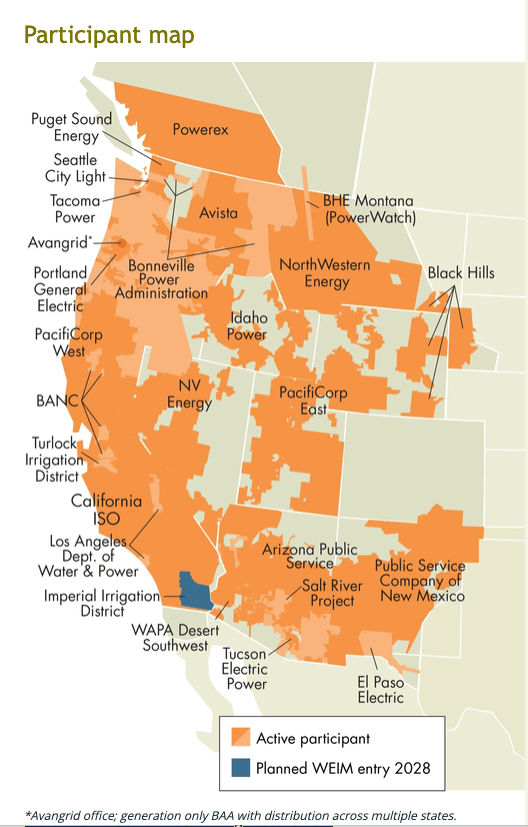
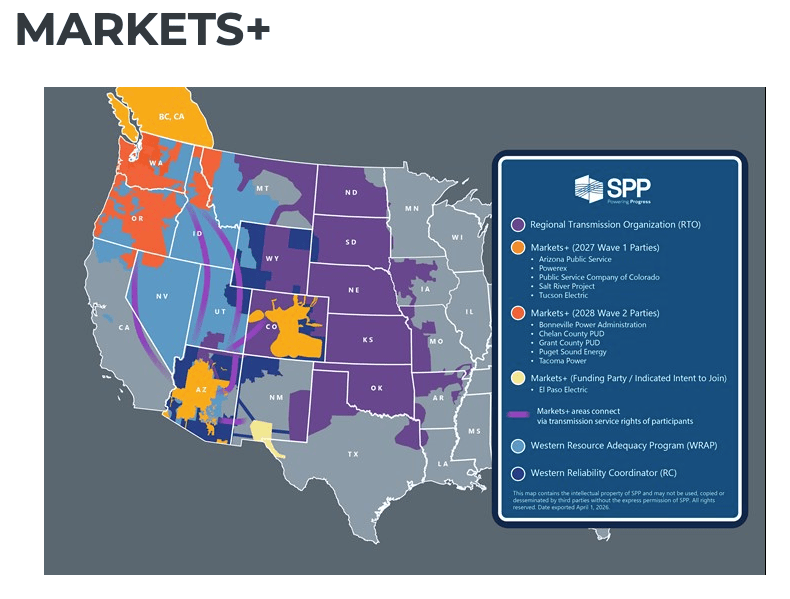
The question of reliability is durational and dependent on when the large number of procured new electric supply resources come online, what demand is during this time, and what other resources are available to serve load during periods of high demand if imports decrease to serve out-of-state load such as data centers. What will happen with increasing demand across the west and how will the coming change that will occur as WEIM shrinks and many of its current participants move to SPP’s Markets + options instead of the EDAM?
See the current WEIM footprint map and a map showing the phases of Markets + below:
Figure 1 WEIM and Markets + Participant Map (October 2026)
If in the future California is unable to secure dedicated, firm imports that equate to a significant portion of the say ~7,700 MWs at 10:30 pm it needed on August 26, 2026, because of changes to demand in neighboring states served by a different real-time and day-ahead market, where will this supply come from? Will the seams process currently undertaken by the Western Energy Market, CAISO, and SPP Markets + be able to adequately address this issue? Should dedicated, firm import capacity becomes a higher priority in the coming years?
California will not be served by the creation of a new real and day-ahead market of Markets + that will optimize to serve its participants. There is an ongoing effort to address the seams created by the new Markets + and existing WEIM and EDAM but it is likely that California will benefit less from a smaller footprint of supply and demand trading and balancing across the west, particularly because APS (Arizona), PowerEx (British Columbia, Canada), and Bonneville Power Administration (Washington, Oregon, Idaho, W. Montana, N. Nevada, and N. California) are exiting the real-time WEIM. It seems likely that California will seek additional firm import supply and it also seems likely that in periods of high demand, California’s natural gas power plant fleet will run at higher capacity factors and duration. We will keep tracking the evolution of long-term forecasting and supply procurement as this picture develops in the coming months and years.
The next series of blogs will continue this discussion and analyze the 2026 legislative response in California to managing the energy supply, interconnection, environmental impact, and electricity cost of large-load data centers followed by analysis of the growing local government moratorium response to data centers.


