Addressing the Role of Electric Vehicles in Greenhouse Gas Reduction: California State Legislative Action

carThis is the first post in a series looking at legislative and regulatory action addressing Electric Vehicle (EV) greenhouse gas (GHG) emission reductions. This first post focuses on state legislative action.

California depends on petroleum for 92% of its transportation fuel needs. Transportation accounts for 36% of California’s total GHG emissions with passenger vehicles accounting for 25.8% of total GHG emissions in the state according to the California Energy Commissions 2014 Draft Integrated Energy Policy Report Update. The transportation sector presents a unique opportunity for regulatory stakeholders to advance technology, policy, and public attitude to reduce GHG emissions.

Continue reading

Posted in Greenhouse Gas, Transportation | Tagged , | 1 Comment

Senator Pavley Introduces SB 32 (2015-2016) to Amend the AB 32 California Global Warming Solutions Act of 2006

The California Global Warming Solutions Act of 2006, generally known as AB 32, mandated that the California Air Resources Board (CARB) adopt both statewide greenhouse gas (GHG) emissions limits equivalent to the statewide GHG emission level in 1990 and rules and regulations to achieve maximum, technologically feasible, and cost-effective GHG emissions reductions. AB 32 mandated that California achieve the adopted GHG emission reductions by 2020. Continue reading

Posted in Energy, Greenhouse Gas | Leave a comment

Regional Transportation Plan Litigation: Fourth Appellate District Finds SANDAG Transporation Plan Violated CEQA

In Cleveland National Forest Foundation v. SANDAG, a three-judge panel from the California Forth Appellate District heard SANDAG’s appeal of a trial court ruling on the first Regional Transportation Plan put forward by one of the state’s nine regional planning entities to comply with SB 375. The trial court found that SANDAG abused its discretion under CEQA with its Environmental Impact Report (EIR) analysis of its 2050 Regional Transportation Plan. The Cleveland National Forest Foundation, the Sierra Club, and the State of California filed cross-appeals expanding the review of the original decision to include additional CEQA challenges. Justice McConnell – with a concurrence from Justice Irion – issued a two to one opinion on November 24, 2014 finding that the EIR violated CEQA. The opinion expanded the CEQA analysis resulting in a modified judgment. Justice Benke drafted a scathing dissent finding substantial evidence to uphold SANDAG’s EIR and no basis for an executive order to become a mandate or CEQA threshold of significance where the legislature has not expressly created such requirements. Continue reading

Posted in CEQA, Greenhouse Gas, Litigation, Transportation | 2 Comments

Climate Action Plan Litigation: San Diego County Appeals Fourth Appellate District CEQA Decision

shutterstock_4540564In Sierra Club v. County of San Diego a three-judge panel of the Fourth Appellate District heard an appeal by the County of San Diego of a superior court finding that the County violated CEQA by not complying with the requirements of its own Climate Change Mitigation Measure CC-1.2 (Mitigation Measure CC-1.2) in its Climate Action Plan (CAP).   The superior court based its decision on the finding that the CAP lacked enforceable GHG reduction measures that would achieve the specified emission reductions under Mitigation Measure CC-1.2. Continue reading

Posted in CEQA, Energy, Greenhouse Gas, Litigation | 2 Comments

AB 2188: Streamlining Permitting for Small Residential Rooftop Solar Energy Systems at the Local Level under the Solar Rights Act

solarpanels_roof_closeup-791688AB 2188, signed into law by the Governor on September 21, 2014 (Chapter 521, Statutes 2014), amends the Solar Rights Act implementing, among other requirements, the first codified streamlined permitting requirement for small rooftop solar energy systems at the local level in California. The bill builds upon existing requirements for local governments that:

  • Discourage passage of unreasonable restrictions on solar energy systems (Government Code Section 65850.5);
  • Require use of non-discretionary permitting process (Government Code Section 65850.5(a)-(b) and Health and Safety Code Section 17959.1(a)-(b));
  • Require demonstration of compliance when seeking state-sponsored incentives but leaves discretion to state (Civil Code Section 714 (h)(1)).

Continue reading

Posted in Energy, Renewable Energy | 2 Comments

Petitions to Re-Hear Denied: The Low Carbon Fuel Standard Still Stands Intact

shutterstock_60487465

(Many thanks to Joseph Mandry for his research and writing for this post).

On January 22, 2014, the Ninth Circuit Court of Appeals denied petitions to rehear Rocky Mountain Farmers Union v. Corey, en banc. Rocky Mountain Farmers Union v. Corey, 740 F. 3d 507 (9th Cir. 2014). Two opinions, a dissent and a concurrence, accompanied the denial.

In response to the court’s decision to deny a rehearing of Corey, Circuit Judge M. Smith wrote in dissent that Corey was decided wrongly for two reasons, and thus, the petition for rehearing en banc should have been granted. Circuit Judge Smith first argued that majority opinion in Corey upheld a “protectionist regulatory scheme that threaten[ed] to Balkanize [the] national economy.” Judge M. Smith said further that the majority was impermissibly nullifying the constitutionally imposed constraints on California’s ability to discriminate against out-of-state producers of ethanol. Judge Smith’s second reason for dissenting was that the majority in Corey “sanction[ed] California’s clear attempt to project its authority into other states.” Judge Smith argued that, by allowing California’s low-carbon fuel standard to survive, the majority’s holding “stand[s] in open defiance” of controlling Supreme Court precedent and renders the dormant Commerce Clause “toothless” in the ninth circuit. Continue reading

Posted in Uncategorized | Leave a comment

Low Carbon Fuel Standard Litigation (California)

Introduction

(Many thanks to Tyler Blix for his research and contributions for this post).

California Assembly Bill 32 (“AB 32”), also known as California’s Global Warming Solutions Act of 2006, set a goal for the statewide reduction of GHG emissions to 1990 levels by 2020. In addition, Executive Order S-01-07, issued by Governor Schwarzenegger in 2007 set a goal to “reduce the carbon intensity of California’s transportation fuels by at least 10 percent by 2020.”  The Executive Order tasked the California Air Resource Board (“CARB”) with the development and implementation of numerous regulations to achieve this goal. In April 2010, CARB adopted the Low Carbon Fuel Standard (“LCFS”) pursuant to AB 32. The LCFS seeks to “reduce greenhouse gas emissions by reducing the full fuel-cycle, carbon intensity of the transportation fuel used in California” by 10% in 2020. A number of fuel suppliers challenged the constitutionality of the LCFS, arguing that it violates the US Constitution’s Commerce Clause and sought to enjoin its enforcement. The case was heard in the United States District Court for the Eastern District of California and  issued in ten orders in December 2011. It was appealed in the United States Court of Appeals for the Ninth Circuit with decision in December 2013. The following is a summary of the main issues and holdings in the litigation. Continue reading

Posted in Energy, Greenhouse Gas, Legislation, Litigation, Renewable Energy, Transportation | 1 Comment

EPIC Presents at Western Energy Policy Research Conference

Western Energy Policy Research Conference 2013

Scott Anders and Nilmini Silva-Send attended and presented at this 3rd Annual conference in Portland, Oregon, Sept 5-6, 2013.

Scott Anders and Nilmini Silva-Send presented on a panel titled “Metropolitan and Regional Planning. ” Nilmini Silva-Send spoke about the effects of CEQA GHG Guidelines 2010 and SB 375 on local and regional greenhouse gas planning and in particular how GHG planning is being shaped by the courts. Litigation by “any interested group” and the Attorney General based on her duty to protect natural resources of the state are so far based on CEQA and the courts are doing what they always do – filling the gaps left by the legislature in application of these regulations. In particular, the courts have held that it is legally insufficient to not take into consideration Executive Order S-3-05 (state goal of reaching 80% below 1990 GHG levels in 2050) in any planning document that extends to that year. Continue reading

Posted in CEQA, Energy, Greenhouse Gas, Legislation, Litigation, Renewable Energy | Leave a comment

Water-Energy Nexus: City of San Diego

This is the second in a two-part series on the water-energy nexus and this post focuses on the City of San Diego. The previous post, discussed the energy and greenhouse gases associated with moving water in the state of California. Generally, the water-energy nexus refers to how energy is consumed and embedded within the water use cycle. A common breakdown separates that energy into two categories:

a) energy use by the water industry, and

b) energy use by the water customer, known as end-use.

End-use represents the amount of energy used by the customer for heating and pumping water in a home, office or facility.

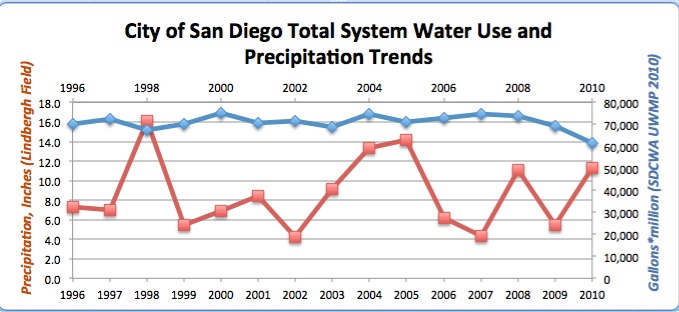
In 2010, per capita water use (end-use) in the City of San Diego was about 125 gallons/day. Total water use has remained steady since the mid 1990’s, decreasing only slightly within the last few years. Also, per capita water use is relatively independent of rainfall.

PPT

Source: Urban Water Management Plan 2010, SDCWA Continue reading

Posted in Energy, Energy Efficiency, Greenhouse Gas | 1 Comment

World Energy Consumption Will Increase 56% by 2040

Yesterday, the U.S. Energy Information Administration (EIA) released it’s annual International Energy Outlook 2013, in which it projects that world energy consumption will increase 56% by 2040.

The report cites growth in the developing world as a primary cause for the increased energy demand, with over half of the total world increase attributable to China and India.

ScreenHunter_114 Jul. 25 10.30 Continue reading

Posted in Uncategorized | Leave a comment