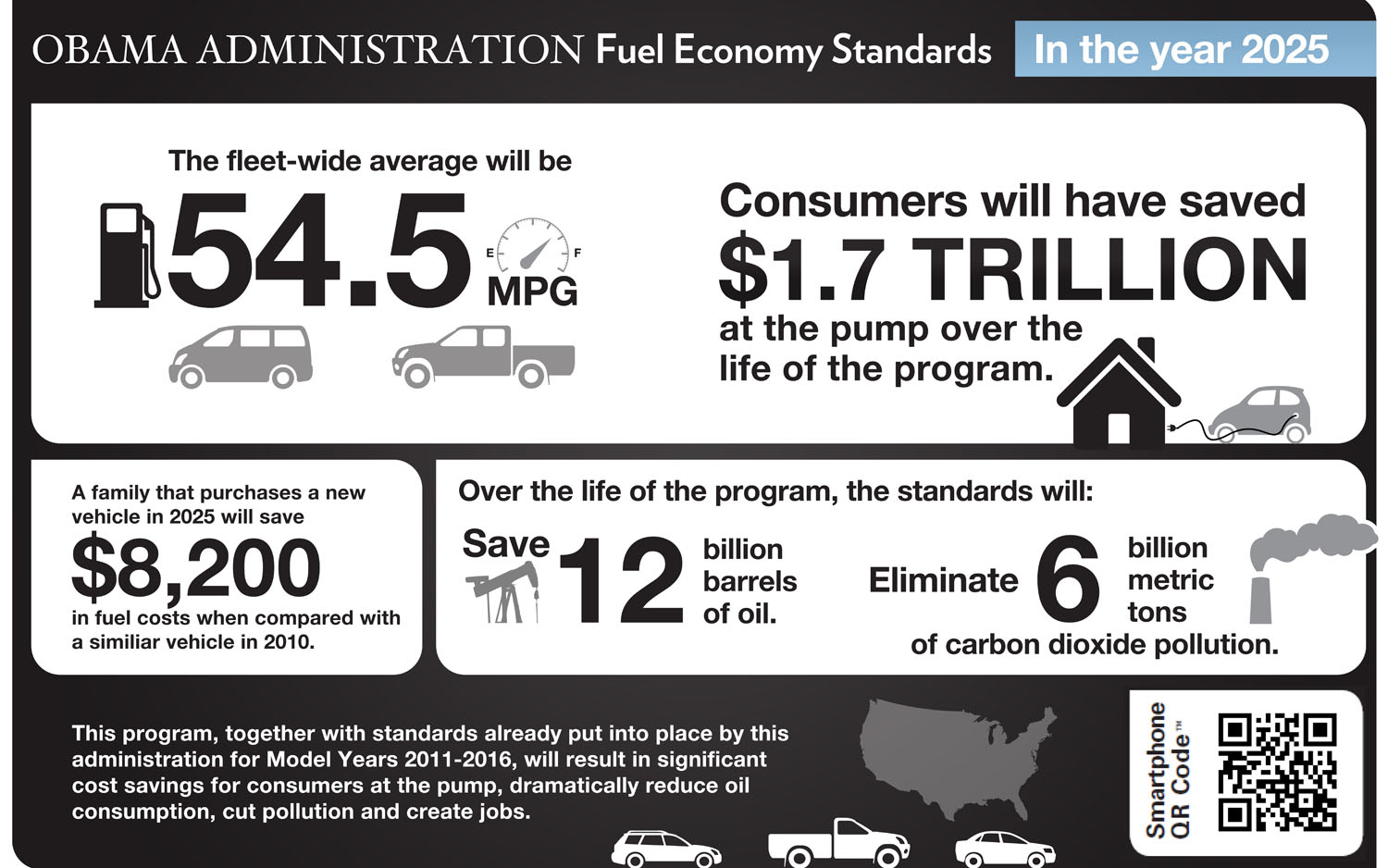
New CAFE standards: 54.5 MPG in 2025

The Obama Administration recently approved new Corporate Average Fuel Economy (CAFE) standards for 2017 – 2025. The new standards are an extension of the 2012 – 2016 CAFE standards.

The announcement of 54.5 MPG by 2025 certainly raised some eyebrows. Let’s take a look at what the new standards mean, and what consumers can expect.

The CAFE standards represent average fuel economy standards. This means that it is the average fleet economy of new model cars and light duty trucks that must meet the 54.5 MPG in 2025. The actual MPG requirement for a given new vehicle is a function of its “footprint,” determined by multiplying a vehicle’s length by its wheelbase. Vehicles with smaller footprints are subject to higher MPG standards than vehicles with larger footprints. For example, the 2013 CAFE standard is 37 MPG for small passenger cars (e.g. Honda Fit), and 22.5 MPG for large footprint light trucks (e.g. Ford F-150).

Here are the new 2025 CAFE standards broken down by vehicle type: Continue reading

Posted in Energy, Energy Efficiency, Greenhouse Gas, Renewable Energy, Transportation | Tagged , , , | Leave a comment

Load Factor

Load factor is the ratio of average demand to peak demand, typically measured in megawatts (MW) on a system wide level. It is a useful metric to show how much of the entire electric delivery system capacity is being used on average over a given period. For example, in 2006, SDG&E system wide peak demand was about 4,224 MW and the average demand was about 2,384 MW. Dividing 2,384 by 4,224 yields a load factor of 55%.This means that on average about 55% of the entire system capacity was used during that year. This is because there are times during the year when demand is higher, typically short durations during hot summer months in Southern California. The electric delivery system must have the capacity to accommodate those peaks. The chart below shows peak demand, average demand, and load factor trends for the San Diego Gas & Electric service territory since 1990. In general, it is advantageous to lower peak demand to a level closer to average demand, thus increasing the load factor. Demand response and other demand reduction programs seek to lower demand during peak times.

Posted in Energy, Energy Efficiency, Legislation | Tagged , , , , , | Leave a comment

Energy Consumption by Sector in the United States

The primary source of energy in the United States has only changed three times in the nation’s history. The U.S. relied largely on wood for cooking and heating until nearly the turn of the twentieth century when coal became the primary energy source in a rapidly industrializing and urbanizing American society. As cars became the dominate mode of transportation, petroleum became and still remains the primary source of energy consumption in the U.S. Continue reading

Posted in Energy, Energy Efficiency, Greenhouse Gas, Renewable Energy, Transportation | Tagged , , , , , , , , , , , , | 1 Comment